Showing posts with label case study. Show all posts

Sunday, 11 September 2011

Lamentation


This entry’s a little outside of the usual subject matter for this blog as it has pretty much nothing to do with animation. It is, however, something that has been on my mind from the perspective of storytelling and the ways in which intellectual properties, once out of their creator’s hands, can develop for better or worse.

I saw a rather disconcerting tweet the other week from my hero and good pal (in my head) Clive Barker – author/artist/creator of “Hellraiser” – which read thusly:
I was kinda surprised, as I’d figured they’d finally hung up the “Hellraiser” socks in 2005 with the unsurprisingly lacklustre eighth entry “Hellworld”. A ninth Hellraiser, or remake of the original perhaps, would at this point only be of value if from the mind of – or at least endorsed by – Clive Barker himself. The only straight-to-DVD sequel he allegedly had anything positive to say about was part 6, “Hellseeker” (2002), which is certainly not without its flaws. So the above Twitter condemnation, along with the whimper the series had supposedly died out on, did not see my expectations raised for this new entry. In truth, I expected it to be hacky trash. How would it be possible, then, to be disappointed by the trailer when, in my head, the bar was already so low? Well, kids, here’s how:

This. Is. Fucking. GARBAGE.
If the above footage somehow managed to make use of untapped computer technology and have YouTube literally urinate directly into my mouth, ears and eyes I’d be less affronted. I’m not even sure who to direct my anger at as there are too many reasons why it’s awful to even begin to count. The recycled dialogue, the dreadful acting, the disorientingly lazy sound mix or the fact that it appears to have been filmed on a flip-cam are all vying for the crown of this film’s shittiness.
Some YouTube comments, along with the film’s Wikipedia entry, have theorised that this is a move by the studio to retain the franchise rights as cheaply (an estimated $300,000) and, in turn, disrespectfully as possible. That explanation makes sense and the silver lining would be that maybe their long game is to put together a more considered reboot of the franchise. If that is indeed the case, then my impulse should be to ignore it completely and let it be the proverbial soundless tree falling in an unpopulated forest.
I guess that’s the real issue – I can’t. I’m genuinely bothered by it. On an intellectual level I can strip the process down and acknowledge it’s an economical solution to a long-term, intellectual property ownership issue. But on a deeper level, one that rationalising has no control over, it’s disrespectful and irresponsible and artistically barren.
“Sure, Ben. Now you’re gonna tell me that a low-budget 80s horror flick constitutes ‘art’?”
How about this - yes, it fucking does. Get them apples down ya.
Clive Barker is an artist, in absolutely no uncertain terms, and the value of art is just as crucially measured by its reception as by its intent. Sure, I’ll admit that a lot of the film adaptations of his books and short stories have been patchy, but the first “Hellraiser”, made in 1987, is a legitimate cultural achievement: An independent British horror film that became a mainstream, international success, while bearing none of the hallmarks or clichés of the genre, then or today.
In true Clive Barker form, the story at its heart is actually quite domestic and relatable. It’s a film about lust for life, human relationships, experience and the torturous nature of boredom; the most common misconception is that it’s about a guy with pins in his head going around massacring people (they saved that for part 3). In fact, it’s fundamentally a love triangle between an austere, bored housewife, her milquetoast husband and his swarthy, dangerous brother with whom she’d had a pre-marital shagathon. So bowled over by his abilities as a master-cocksman, when she meets him again as a skeletal escapee from hell she doesn’t bat an eyelid.
She’s also more than happy to let loose her repressed murderess side and kill a string of horny barflies that her reanimated lover can feed on to become a whole person again. What gives the film its uniqueness is its focus on realistic, human issues juxtaposed against the darker, surreal visuals and concepts. These two scenes are a nice little glimpse into that overall vibe:

That the ‘horror’ elements are so casually incorporated into the story gives them a lot more weight and even legitimacy. The villainess (or antiheroine) Julia isn’t a one-dimensional hacker-upper, her motives to self-servingly indulge the sociopath within aren’t so far-fetched when you consider the despicable behaviour of real-life nutjobs; next to the Tracey Connellys of the world she actually comes off as fairly tame.
Fleshing out the story further are elements good, bad and ‘meh’ – the reluctant, unlikely stepdaughter heroine (good), her completely ineffectual boyfriend (meh), the cenobites, a kind of underworld, S&M-inspired mafia/clergy, of which the then-unnamed Pinhead is don/high priest (superb) and...well, there’s this bit with a giant scorpion thing being wheeled down a hallway...yeah, I’m not too wild about that.
Another big gripe is that, presumably for reasons relating to marketing the film internationally, a lot of the British actors have their lines overdubbed with American accents. So, as with everything in life, it isn’t perfect, but there’s so much to it that works so well and, frankly, puts it on a higher plane than other genre movies of the era. This virtue is, ironically, what limits its audience somewhat – it’s just easier to sell a brainless slasher flick if you’re going under the horror label.

"For the most part, the reviews have been extremely kind. The audiences seem to have been having a good time with it, which is a major satisfaction. So I would have to say yes, I'm satisfied. I think it would be great if some of the images from the movie become images which recur in people's heads and stick with them. I would really like to see a Hellraiser series get going. I'd like Julia to be the first running character in a horror series who's a woman, like a female Freddy Kreuger.”
- Clive Barker (Fall 1987), justifiably ambitious and hopeful.

Naturally enough, the film’s unprecedented success spawned a more or less immediate sequel “Hellbound” (1988), which Barker was less involved with but was penned by his former theatre troupe co-founder Peter Atkins (who would also write parts 3 and 4).
As the film goes on, Atkins’s grand vision starts to work against it, the budget just not sufficient enough to accommodate the spectacle of hell he’d envisioned. The first act of the film is superb, though (aside from the bizarre presence of cornball US detectives further confusing the geography of the films), echoing Barker’s explorations of human obsession. The scenes that really stand out deal with the relationship between a psychiatric doctor and the reborn villainess Julia:

Another standout moment of all the films takes place toward the end of “Hellbound”, where the cenobites acknowledge their own origins and face-off against the doctor, himself now cenobitised and looking to oust them (just to let you know - MONUMENTAL spoilers in this clip, in case you plan on giving the films a proper watch):


“To catch the momentum and consciously carry on the mythological development was a challenge I found irresistibly exciting. Hellbound illuminates many of the concepts I was happy to leave as mysteries in Hellraiser while continuing on a spiral of weirdness I can develop even more in a third film.”
- Clive Barker (01/1988), excited enough about the sequel to already be aiming for a trilogy.

At this point the films had developed a pretty sizable audience who’d embraced Pinhead more than the human villains of the film (this essentially put the kibosh on Barker’s aforementioned vision of Julia, the housewife-turned-Queen-of-Hell from the first two movies, becoming the series’ main antagonist). An ambitious comic series was spawned (separate entry for that coming soon) and, after several variants on a storyline were developed, a third film was pushed out in 1992.
“Hell On Earth” takes a pretty gigantic turn as an unashamed slasher movie, wherein the former cenobite leader (he with the nails in the ol’ noggin) goes into the freelance business of pretty much slaughtering everyone in his path. As a viewer, it’s fun in the vein of shamefully wolfing down an entire box of chocolates, yet despite going against the M.O. of the first film by retreating to a more conventional type of horror flick, it’s still peppered by wonderfully incongruous moments of Atkins-scripted dialogue that are so well-written they almost seem as though they’re from a different film altogether. These mainly center on a series of ‘seduction’ monologues Pinhead (Doug Bradley) delivers, the clip below being, in all seriousness, probably one of my favourite scenes in a movie ever:

Also to Atkins’ credit is that the contradictory character Pinhead has in this movie does make perfect sense, story-wise. Having been stripped of his humanity in the previous film, he now exists purely as impulsive evil, hence a somewhat Krueger-ised persona. This concept I will happily admit to being my main inspiration for Erica, the villainess of “Mitchells In England” (in fact a whole heap of the story elements were more or less lifted directly from “Hell On Earth” in, y’know, loving homage). At this point in the series, though, Barker himself had been elbowed out, only really being brought on for reshoots to fix the somewhat anticlimactic ending.

"From the start it was clear the production company [Trans Atlantic Entertainment] wanted their stamp on it more than mine. While they had to pay me because the original ideas and characters were my creation, they already had the pivotal elements in place, so they didn't need me. As it didn't reflect my vision of the Hellraiser mythos, I had no desire to be associated with it in any way.”
-Clive Barker (03/1993) on the reality of the third movie.

The film is a cringefest, full of one-liners, gratuitous tit shots and questionable VFX – and I do indeed love it. While the first “Hellraiser” nourishes my craving for well-crafted, story-driven cinema, the third equally satisfies my guilty penchant for brainless cheese (with the second pretty much bang in the middle). As a trilogy these films are solid, thoughtful at times and joyfully macabre.
Imagine my delight, then, when I discovered that a fourth was coming out, pretty much exactly when I was getting into Barker and the “Hellraiser” series. Thus began the descent of the franchise into a succession of production nightmares. My fascination shifted from the stories of the films themselves to the real-life, behind-the-scenes woes that were being reported.
The heartbreaking thing is that “Hellraiser: Bloodline” (1996), in screenplay form, had the makings of being the best one of the lot, irrefutably concluding the largely unexplored mythology of the films by bringing it full circle to its origins in the 18th century. The evidence of Atkins’s work as a quality writer previously glimpsed in moments of parts 2 and 3 was this time laid on thick. Fortunately some of these scenes made it to the final version, albeit framed in a misrepresented context – the film as released is a confusing, detached patchwork with gaping continuity issues and inconsistencies. This one surviving exposition scene from an entirely excised subplot just about works in its own right, and more importantly shows the potential the film could have had:

It has to be said that, for the most part, only after reading the original screenplay do certain scenes or lines of dialogue make any sense whatsoever. This film was also my introduction to the concept of the Alan Smithee pseudonym, put to use after director Kevin Yagher had the film he was trying to realise wrenched away from him to be bombarded with script revisions and reshoots.

“When a filmmaker wants to make a movie based on my work, I can't say, "Well, I'm not going to become involved." Instead I keep my finger in the pie and try to create a better movie. However, as the series goes on, it becomes harder and harder to scare audiences with images that they've seen in the three previous films…Hollywood is built on pure profit and, provided there's a profit, the concept will continue - even if there isn't a brand spanking new story to tell."
- Clive Barker (02/1995), wearied industry veteran.

I have absolutely no qualms with admitting that, as far as I can tell, in the hall of fame of shitty horror movie sequels there have been far worse than “Bloodline”. Its main problem is simple – it isn’t finished. There are still a lot of strong moments and cool concepts buried beneath the mishmash plot.

The ending is irredeemable though, inexplicably sudden with no epilogue or explanation, the consequence I assume of a rushed rewrite so that the hero survives. Workprints of earlier versions of the film exist, some containing scenes from the screenplay that were filmed but left out of the released movie. One of these is an earlier version of the ending (in which the hero makes the far more poetic and justified move of sacrificing himself), which is not only better, it honestly gave me chills – no mean feat given how much harder an onscreen timecode and the absence of VFX, music and sound make suspension of disbelief. When I finally watched it a couple years ago I actually felt like I was at peace with the film; it’s how things should have ended.

"Hellraiser 4 has been released in the States. It's not very good. I think they are making another one. Oh God!"
- Clive Barker (07/1996), candid realist.

1-4: The more profitable, theatrical-run days...

So, in the wake of the clusterfuck that was the fourth “Hellraiser” (which made it into cinemas in the US but was the first straight-to-video entry in the UK), the series’ future on the home video market was pretty much set in stone. I made a point of keeping expectations low for the fifth (2000’s “Inferno”), which proved to be the right move as it was something of a poor man’s “Jacob’s Ladder” and the first to no longer involve Atkins. The aforementioned “Hellseeker” was similar, story-wise, but redeemed by its atmosphere and performances. Its main problem is a jarring and disconnected storytelling style, where events constantly jump forward and backward. The explanation at the end justifies this device well enough, but frankly it gets pretty irritating to sit through. All told, however, it’s the most commendable stab at a “Hellraiser” movie out of the final four.
5-8: Straight-to-DVD hell

The seventh (“Deader”, 2005) and eighth are uniquely fascinating – in their own rights they are inoffensive-yet-mediocre horror flicks. Here’s the thing, though – they aren’t “Hellraiser” movies. Curiously, and rather lazily, the studio made the move of optioning screenplays for films that were never intended to be part of the franchise, and it’s glaringly obvious that any “Hellraiser” story/mythology elements are awkwardly crowbarred in, conflicting with their intended plotlines. But I suppose if you’re an aspiring screenwriter and you’re desperate to get a film made, you’ll happily slap “Hellraiser” on the title and give Pinhead a cameo if not doing so is the deal-breaker. So, for that reason, I have no real issue with them, because they really don’t count. Also, Kari Wührer is in one of them and she’s hot.

“It's painful, because I loved making this movie; I loved making the second movie; I actually had a good time at the third one, and then it started to fall apart. The reason it falls apart is because of certain people who are not creative, who are pencil pushers, the people who went to business school, who went to law school, who have absolutely nothing to do with the creative process who think they know better than creators. And this town is full of them!”
- Clive Barker (08/2000), at this point really kinda bumming me out.

I think what is more aggravating with the new one about to be released is that it was commissioned as a “Hellraiser” movie from the outset, but with none of the time, money or respect such a film deserved. Thankfully Doug Bradley turned it down, but I’m staggered that they would make the horribly misjudged move of including a version of a character as iconic as his played by another actor. The timing is also atrocious, given that in a couple other respects the franchise on the whole is going through something of a resurgence. This year’s series of new “Hellraiser” comics have been flying off the shelves (at least they are here in Bristol) and, being co-written by Barker himself, are going to places far darker and ambitious than the generic fare we've been subjected to of late.Also my hopes are still high for the mythical Barker novel “Scarlet Gospels” which will reportedly close the door on the “Hellraiser” universe in his own way, one that he was unable to do via the films themselves.
What began as a venting session has, as it turns out, become something of an essay so I’ll try and make some kind of point out of my concerns. Nearly three years ago, my thesis film “House Guest” was picked up for development by a Canadian production company, one which has yet to set the world alight. The hope was to rework elements of the film, extending it into a twenty minute pilot that would be the basis for a thirteen-part miniseries, and go from there. What ensued was six months of the most disenchanting back and forth BS I’ve experienced, where every note from them kicked what I was trying to achieve square in the solar plexus of the balls (I appreciate that doesn’t quite pan out anatomically, but work with me here). At the point where they had redesigned the characters to look like an infant’s Chibi doodles I took the first window of opportunity and bailed the fuck out of it. And thankfully the film, untampered with, went on to perform well enough. I had virtually the same exact experience last year while attempting to develop a separate property with a fairly high-profile UK children’s book publisher. That ended on far better terms and with significantly more hope for a future working relationship, but still the issue remained that, over time, it morphed into something I barely had any association with. In all likelihood, this is gonna happen a lot over the next few years. And I’m not entirely sure how to feel about that.
So instead I’m going to ignore it for now, break out a certain DVD boxset, get a shitload of cheap Grigio down me and fall asleep listening to the commentary tracks. G’night.


Props to Phil & Sarah Stokes's official Barker site "Revelations", from which I pilfered the quotes. Also to Paul Kane's thorough and fascinating book "The Hellraiser Films & Their Legacy" which was pretty eye-opening.

Thursday, 11 August 2011

Those little reminders that we're all hurtling towards death...

Art from "Ren's Retirement", season 3

The alarming revelation that "The Ren & Stimpy Show", probably my most crucial influence, debuted twenty years ago to the day means one thing above all else: I'm officially an old piece of shit. So in honour of this, here's a drawing I did to test out my Cintiq the other month:
I'm generally not into fan art, mainly because of the sociopathic insistence people have on putting the characters into horribly unpleasant sexual scenarios (although in the case of Ren & Stimpy John K already did that with the Lost Episodes). The old man behind them is Wilbur Cobb, one of the lesser-appreciated, post-Spümcø characters that I always had a fondness for as he was a dead ringer for my own granddad, right down to the coughing fits, missing body parts and talking in non-sequiturs.
About five years ago I slapped together a presentation on the show during my Animation MA, and threw it online when I first started this blog. it's a little patchy and my voiceover for it is horrible (and as a man who loves the sound of his own voice that's a telling admission, my friends) but what the heck, this seems like an appropriate enough occasion to dust it off:

Sunday, 22 November 2009

All encountered out. Now back to shunning society.

A few more standout films from Encounters, which finished last night.
'Over & Over (& Over) Again'
- Dir. Andy Glynn
Very effective and thoughtful piece on teenage OCD. Perfect length, well performed and with justified use of motion graphics in relation to the dialogue and subject matter. While I haven't watched the others yet, it looks like a number of other films produced by the same scheme 'Animated Minds' dominated the animation contingent of the festival's Best of British screenings. Will give these a look sometime during the week as it seems like a pretty interesting idea.
Some more:

Friday, 20 November 2009

That's right, there's stuff that I actually like. Who'da thought?

It's Encounters week in Bristol, and as ever the festival has pulled together a bunch of disasters and triumphs in pretty much equal measure. The locality of this particular festival inevitably guarantees the inclusion of people I know, so there's usually a bit of a celebratory vibe in the air. Going back and forth between debilitating throat pain that sees me prone to screaming in old ladies' faces like that thing in 'Come To Daddy' and happy clappy co-analgesics that see me prone to drooling and giggling at cutlery, I've been mainly housebound and a little more selective in terms of which screenings I attend than in prior years. So far however there have been a few standout moments:

El empleo from Hayyam on Vimeo.

A few others of note produced by the Animation Workshop include 'Project: Alpha', 'Trainbombing' and Nicole Gallagher's 'Sheep'. Who doesn't like sheep? The main draw so far was a showing of the new Adam Elliot film 'Mary & Max', a feature-length endeavour with Philip Seymour Hoffman. I've previously banged on about the excellence of Elliot's 'Brother'/'Cousin'/'Uncle' trilogy, as well as the fabulous 'Harvie Krumpet'. What ties each piece together are memories, accounts and stories that are fundamentally about living with mental illness.My absolute favourite, 'Cousin', describes perfectly the frustrations, limitations and awkwardness of cerebral palsy without the merest hint of condescension, and it's apt that his first feature would deal with Asperger's, the psychological disorder du jour*.
Hoffman distinguishes himself from most screen actors who, when voicing a cartoon do little more than provide a name with pulling-power to a movie poster. As Max he's authentic, funny and, at times, disquieting, portraying a social recluse who, when eventually diagnosed as an 'aspie' sees no reason to change. By chance he is randomly contacted by a young Australian girl in search of a pen friend, a relationship that appeals to him by virtue of distance. Over time they become one another's repository and their correspondence is soon associated with all the major events of their lives.I have to confess that I personally tainted this film (almost) with unfairly high expectations and consequently found my mind nitpicking at its small handful of flaws. After a few days though, these issues are pretty inconsequential. Possibly the story could have had better pacing, or the odd voice actor swapped out, or they might have taken it easy with the Penguin Cafe Orchestra. Any other issues were very quickly dwarfed by the strength of the dialogue, subject matter and affectionately crude visuals.
I don't see this film getting major distribution which, along with discovering the existence of a strange, two-headed creature named Jedward, is one of today's contributions to my list of Reasons To Welcome Death.If you can track it down it's very much worth the extra effort.

*I'm pretty certain a lot of successful animators I've met in the last couple years have some form of high-functioning autism - I suppose it goes hand in hand with all the time you need to spend alone in front of a lightbox, computer or set. Watching these creatures in social scenarios, one witnesses a bevy of awkward shuffling, one-word answers, avoidance of eye-contact and general ineptness that hangs in a room like a bad smell. Of course I behave that way a lot of the time too, but that's just 'cause I'm your run-of-the-mill dickhead.

Monday, 13 April 2009

Taking the Fun Out of Toys

It seems to me that too many have misinterpreted St. Paul's famous line:
"When I was a child, I spake as a child, I understood as a child, I thought as a child: but when I became a man, I put away childish things".
I'm not a scripture guy, but that's a quote that has some resonance with me. I'd assumed it referred to growing beyond the feelings of entitlement, angst and confusion we're plagued by during infancy and adolescence; A well-rounded adult should be able to acknowledge and eliminate (or, failing that, tone down at least) the distinctly childish aspects of who they once were, which by and large are negative - selfishness, arrogance, occasionally pissing oneself and so on.
What I'm seeing more and more of as I get older are adults who retain these charmless qualities whilst completely abandoning the joie-de-vivre, playfulness and curiosity that represent the positive side of childhood. They're putting away the good childish things and holding on to the wrong ones. The end result? Douchebags.
A lot of people also seem to take the phrase a little too literally, which brings me to the point of this post. Oftentimes folks actually 'put away' (or trash, or sell) the toys, games, books et al from when they were growing up. These things become embarrassments, articles that have been 'grown out of' and left behind. All I can say to that attitude is this:
"Shame! Shame on you all, you poor, deluded fools!"
This is for a couple of reasons - primarily that I rarely get the chance to call people 'deluded fools' and I embrace it when it comes. Also, I'm somebody who has never gotten rid of his 'childish things' in the physical sense - they're either all stored safely in my mother's attic or have been brought over to my apartment. Their function doesn't go beyond being ornamental, but just having them around is a positive reminder of who I was, where I've come from and why I'm here.Being a guy who finally came out of the geek closet and walked into a Forbidden Planet for the first time in 2003, I still succumb to the temptation of picking up character toy tie-ins of interests past and present. If I see a 'Big Lebowski' John Goodman toy, why, it just makes sense that I should own it. A battery-powered Roadrunner Pez Dispenser? Ring 'er up! They make a Starbug that opens up, shoots missiles and makes noise? Why didn't this happen sooner?!
Well, I'll be. Turns out all three of those things actually exist...
I have to moderate these indulgent purchases, especially in this climate when all money really does need to go toward, y'know, being able to live. If I had the means then there'd be no room to move in my flat for the Nightmare Before Xmas paraphernalia alone. But there's nothing wrong with the odd one, here and there - it's far more honest deco than any crappy department store-bought sculpture. It's who I am, which happily coincides with how I'd like to be seen. Oftentimes people find those two at odds with one another.Here's something that confuses me though - designer toys. I'm not entirely sure what the function or audience for these is. Is it so that people who secretly want to have toys on display can refer to it as 'art' or 'ironic' if anybody gives them grief? Are they just for people who'll collect anything and have more money than independent thought? Are they actually very fun and expressive while my small brain just doesn't get why?
They certainly make use of a very 'in' character design aesthetic, whose origins seem to combine South Park and old videogames in their symmetrical, big-head-little-body theme. Some companies such as UNKL rarely deviate from one model per line, the differences between characters entirely down to the graphic design, treating the generic shapes as a type of blank canvas.
UNKL's limited edition Ipecac range, probably the only instance of a Mike Patton toy ever being made. If they threw a Rahzel in there I'd buy the set.
I've been meaning to expand on my character design work, as I haven't had many opportunities to take on different styles. Given the simplicity of these types of avatar-esque characters, it seems worthwhile to experiment with some of my own, either for portfolio purposes or maybe to promote some of the new music I've been working on.
Here are some geometric sketches that I plan on referencing for CGI modeling. Starting with a cheap'n'cheerful, ultra minimalistic version of me and some other characters to get the ball rolling.


And here's a very fast, cel-rendered model that I whipped up on the fly to get an idea of an end-result visual.I'm thinking there's a new music video in this - this type of design work goes a long way toward selling a product. In 2006 my third Struwwelpeter album 'Agnosticaust' outsold any prior release by a long stretch, and several buyers who got in touch chalked that down to the album cover, which roped them in. It was adapted from a rabbit character I threw together for one of the music videos, which I would have made more detailed if it weren't for time restrictions. So one of my most successful design pieces (a shirt produced bearing the same design actually outsold the CD itself) turned out to be a complete accident.
In the meantime, I'm off to play with my old GhostBusters car and ponder why I'm not in any kind of committed relationship at the moment.

Sunday, 8 March 2009

Guess what band I'm gonna talk about in this post?

I realised something this week, that pop-culture in 2009 has become eerily tailored to my tastes. There's nothing new that really grabs me, but some old franchises are being revived. The Rocky, Rambo, Indiana Jones and Transformers fans of the world were, in the last couple years, treated to new outings for their beloved childhood protagonists. Not having much nostalgic investment in those properties, I felt a little bit left out. Well, actually I didn't really give a crap either way, but let's say I did for the purposes of setting up this entry.
2009 so far promises three triumphant revivals from my own childhood - one being, of course, the completely unexpected return of Faith No More. In June there's the GhostBusters video game, an equally unexpected revival bringing back the original cast, including Bill Murray (who was to GhostBusters as Mike Patton was to Faith No More in their shared insistence on never being part of any reunion).The third franchise being resurrected is another pleasant surprise - Red Dwarf. I would've put money on that ol' chestnut staying dead'n'buried, but in April they're dusting it off and giving it a handful of new episodes that might hopefully resolve the cliffhanger it ended on a decade ago.
Faith No More, GhostBusters and Red Dwarf? Those made up, like, 70% of my pre-adolescence! What's next - is David Lynch gonna whip out a sequel to 'Fire Walk With Me'? Are they gonna do a 'Bill & Ted 3'? Is Raul Julia gonna have the good manners to come back from the dead so we can have a proper new 'Addams Family' movie? Will Clive Barker finally release the fucking 'Scarlet Gospels'?
When I previously used the phrase 'triumphant revivals', I did so whilst knocking on wood. After all, they haven't happened yet, so I don't really know how triumphant they'll be. Y'see, friends, I'm cautious - I've been burned before...
Faith No More's final LP 'Album Of The Year' is notable for being merely great, as opposed to their three albums prior that were incandescently brilliant.
Okay, bad example.
But that same year (1997) there was an attempt to bring GhostBusters back with...ugh...'Extreme GhostBusters', an ill-advised, 'hip' update with youthful character replacements that ticked every ethnic box. It wasn't horrendously awful, and as an animation fan there's some fun in the visuals, but it's painful messages (tolerance, equality and a number of other social issues that, by that time, should've been a given) undermined themselves in their lack of subtlety.
Also in 1997 (kind of a weird coincidence in retrospect) the brilliant 'Red Dwarf VI' was finally given a follow-up - the dreadful 'Red Dwarf VII'. Two years later came 'Red Dwarf VIII', which wasn't as bad but was still no great shakes.
These were all forgivable enough, however it was a completely seperate revival that took my beloved childhood memories and literally screwed them in the arse...

To be continued...

Thursday, 4 October 2007

Case Study: "Float over here so I can punch you"

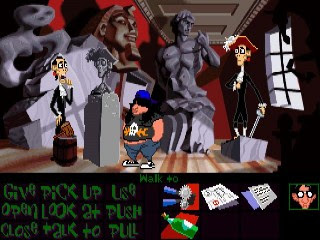
Cower, bitch!If I were to do the fair thing and disregard the Super Mario franchise, my two fondest memories of playing video games as an adorable whippersnapper also happened to be, in their own way, two of my biggest creative and stylistic influences (in visual terms). This is no doubt because they themselves were inspired by the classic, manic era of animation that hit its stride in 40s and 50s. 'The Simpsons' had reminded the world that cartoons could be smart and dialogue-driven, 'Ren & Stimpy' had reminded the world that they could be insane and unrestrained. This renewed interest in animation during the early 90s bled into some video games which had, by good fortune, just about reached a level of technological sophistication that accommodated it. One such game was 'Earthworm Jim', which at some point I'd like to devote a separate entry to. The game that ever-so-slightly trumps it was a revelation to a lot of console-oriented videogamers like myself at the time.
Back in my day, video games came in needlessly huge cardboard boxes. None of that 'convenient' snap-case BS for us!'Day Of The Tentacle' (a 1993 sequel to the 1987 game 'Maniac Mansion' which had already become an old chestnut) was one of the earliest examples of a point-and-click adventure that was, essentially, an interactive cartoon. To a nine-year-old this was a truly wondrous concept, and in my not-quite-adulthood it has dated surprisingly well, for a number of reasons:
  • It isn't easy, but that being said I have the entire walkthrough eerily memorised to this day. I say 'eerily' because I can't even remember what I ate for breakfast yesterday.


  • It's still pretty funny, for not necessarily the same reasons, but lines like 'Ted is red, see red Ted' still keep me a-chucklin' like the silly bitch I am. At the time to just have the characters speak at all was brilliant enough.


  • The excellent sprite animation, obviously the more pertinent aspect in the context of this journal. Clearly a love letter to Tex Avery, Chuck Jones and that whole rat pack, it featured superb character acting, fluid motion and some nice dashes of craziness. The background paintings were especially gorgeous to look at in all their pixellated glory.
The game had some seriously nice backgrounds to stare at while you worked out what the hell you were supposed to do nextThe premise was fittingly nonsensical, referring to exposition set up in 'Maniac Mansion' (which I never got through) the player switches between three college students who explore the same building in the past, present and future respectively. The gameplay involves using one, two or all three characters to solve a series of bizarre puzzles - an example of the abstract thinking required being: the guy in the past needs vinegar to help power a battery, so he has wine transported from the present which he then seals in a time capsule. The girl in the future then has to locate the capsule, open it and send the bottle of what-has-now-become vinegar back to the past. Seriously, you needed that walkthrough...Chron-o-Johns!As with any successful cartoon, the characters were endearing and nicely developed - Bernard, a booksmart sort-of-leader; Hoagie, an overweight, hairy music enthusiast who I seem to have alarmingly morphed into; and Laverne, who is either baked or semi-retarded - either way every girl I wound up dating has reminded me a little of her. I guess this game seeped into my life in many ways. Bernard, Laverne and the strangely familiar Hoagie...The supporting characters were also well-conceived. The family of villains from the previous game are now semi-allies, although in 'Tentacle' you cannot die, so pretty much all the characters have some function or other that you need to harness to move the story along. They are essentially props with well-written dialogue.
Another crucial contributor to the game's overall environment - as, again, with any decent cartoon - was the music, which was expertly orchestrated and timed, and yet the factor that dates the game the most (it is a feast for the ears if you can get passed it being General MIDI).
It's tempting to simply list all the quotable dialogue, ingeniously-crafted puzzles and twists that made the game such a work of art, but neither you nor I have that kind of time. Well, okay, you probably don't. However, thanks to that ever-resourceful archive of pop-culture that is YouTube, here are some clips I found:


As a sidenote, I'm glad that these are mostly clips from playing as Laverne as she was my favourite. I'm not sure whether the voice actress's monotone reading of her dialogue was deliberate or because she was just awful. Either way, it's brilliant. The (sadly absent in these clips) highlights of her performance would be the occasional manic giggling she'd launch into apropos of absolutely nothing. But I digress...
Laverne: Creepy yet strangely hotThis game was a huge influence on 'Mitchells In England', if for no other reason than it sparked a desire to create my own cartoon universe with my own characters. Eventually when I got my sea-legs, drawing-wise, a lot of visual derivations started to appear. This has also been the case with 'House Guest', and as I get more comfortable with the animation process and the urge to get a little ambitious with it, I find myself reminded more and more of 'Tentacle'. It has me wondering whether my generation would be the first to actually count video games as a legitimate creative influence. It also makes me a little sad that polygonal, 3D gaming took over so shortly afterward and the marriage of traditional 2D animation and the gaming world never really developed far beyond the 16-bit era. Frankly it's a little jarring that things I hold dear to my heart from my childhood are already being dismissed as passé - shit, I didn't think it'd happen so soon...
Thanks then to the basement geeks who developed console emulators and ScummVM. I can stay mired in the past indefinitely! If the game can be located, I'd urge anyone with an interest in animation history to give it a whirl. I honestly consider it to be a frequently-overlooked milestone.
If you didn't find this bit funny you will miss out on everything worthwhile in life and die angryAnd 'Sam & Max' wasn't too shabby either.

Tuesday, 8 May 2007

Case Study: 'La Science des Rêves'

This entry actually relates specifically to my Research Methods module, but given that Gondry is a pretty big influence on me and that the film in question is part-animation, I figured there'd be no harm in including this as an additional case study.

The trickiest thing about looking at a movie by a director (or any piece of art, by any type of artist) one admires is to see it in its own right, disregarding all previous work. This is especially difficult when reviewing Michel Gondry's recent film 'La Science des Rêves' ('The Science of Sleep') as it is visually reminiscent of almost every project he's previously put his hand to. As a consequence, comparisons inevitably shape this review. The film, which did not receive wide distribution (bless the Watershed), is Gondry's first written feature, although he's already been firmly established as a director for a number of years now. Through a myriad of dream sequences, hallucinations and shared fantasies it tells the story of Stéphane, arriving in France from Mexico to take up his dream occupation only to discover that he has been woefully misinformed about the nature of the work. While dealing with his disillusionment he forges two friendships, one with his unabashedly sex-obsessed work colleague Guy, the other with his neighbour Stephanie, with whom he shares a creative bond. When his initial romantic infatuation shifts from a casual interest in her friend Zoe to Stephanie herself, his propensity to fantasise grows exponentially to the point at which it starts to encroach on his waking life.
In many ways this film retreads a lot of familiar visual ideas - in fact, at times it seems to directly reference numerous prior works, most of which being music videos, Gondry's (like many modern film-makers) primary medium before moving onto feature films. A lot of technical devices and shortcuts will be familiar to Gondry enthusiasts - the crude construction of sets (Stéphane's mindscape is primarily made from cardboard) and projected backdrops especially.At one point Stéphane wakes to find his feet in a freezer, presumably dragged into his room somnambulatorily to synthethise arctic terrain, a scenario that recalls Gondry's kaleadoscopic video for the Chemical Brothers' 'Let Forever Be', in which a young woman flits between conscious and unconscious states, finding elements of dreams bleeding into real life.
Another sequence in which Stéphane's dream persona battles his co-workers with oversized, cartoonish hands harkens back to the Gondry directed music video for 'Everlong' (Foo Fighters), in which the band's singer Dave Grohl does likewise to save his drummer Taylor Hawkins, in drag as a damsel-in-distress. This cinematic convention of the lady in peril was also worked into 'Eternal Sunshine...', seeing Jim Carrey's uncharacteristically-subdued lead Joel desperately try to preserve the memory of his former girlfriend by dragging her through various unlikely recesses of his brain. In 'Les Sciences...' the premise is adapted somewhat, but the splitting of the prospective love interest into two separate characters - one real and flawed, in a sense unremarkable, the other a dually romanticised and idealised figment of the protagonist's imagination - remains. When a lovesick Stéphane sees Stephanie apparantly succumbing to the charms of another man, her fictionalised doppelganger apologises profusely from within his brain. Similarly, in 'Eternal Sunshine...' Joel imagines the fading memory of his former lover Clementine apologising for emasculating him early on in their relationship, an atonement she never proffered in real life. This device is perhaps the most relatable element of two decidedly-abstract love stories, that our minds, when afflicted by love, will deify those we're attracted to, and the profound disillusionment that comes with the eventual realisation that they are only human.
When he isn't referencing himself, Gondry draws upon the trademarks of a handful that have come before. The minimal yet decidedly eerie dreamscapes of David Lynch are a definite presence, as well as the hallucinatory miscreations of David Cronenberg's earlier work, Gondry's distinctive take on such approaches being to present them in a more lighthearted, overtly 'daft' context. An early dream sequence, brought on by Stéphane's fascination with a malfunctioning electric shaver moving itself across the floor, sees the device mutated into a mechanical arachnid whose function is reversed, causing it's victim's facial hair to rapidly grow. Perhaps a more direct influence on these sequences, and one which has not been so prevalent until this film, would be the use of pixellation and overall sense of aesthetic of Jan Svankmajer. With the exception of an interesting pixellation experiment with Lego blocks for a White Stripes music video, Gondry is not best known for animation. In 'Les Sciences...' however it is a consistent theme, reminiscent of Svankmajer's short films and in particular his abstract take on 'Alice In Wonderland', the more succintly-titled 'Alice'. The animated characters that, visually, hover between being ridiculous and being unnerving, as well as the use of delapidated, derelict house interiors as set-pieces are shared traits of both films. It is also worth pondering whether or not Gondry's experience of working with screenwriter Charlie Kaufman on 'Eternal Sunshine...' was in itself a direct influence on the screenplay. In many respects both films are thematically similar - an awkward (bordering on irritating) but identifiable and sympathetic lead, an unlikely love-interest ...However, while the sting in 'Eternal Sunshine...''s tail seemed to be that the portrayed couple are doomed to go in a loop, repeating the same mistakes yet being drawn to one another time and time again, the decidely less mythic premise in 'La Sciences...' is that the couple are simply doomed before they can begin, affections being entirely one-sided and unreciprocated. For what is seemingly a small difference in detail, this element makes the film an altogether different type of love story, one which is perhaps exclusive to Gondry as a screenwriter as 'Eternal Sunshine...' was to Kaufman. While being, in technical terms, amusing and enjoyable (if not especially brilliant or innovative), the story on which the eye-candy is predicated has genuine soul. Essentially it's a study of how love in a real, unromanticised sense can be a stifling, obtrusive handicap that marrs one's rationale. In this instance, it engulfs the lead to the point where he is both unable to even function in a work environment and, more tragically, attempt the preservation of what could potentially be a meaningful friendship with the woman he cannot have. It's not a topic that lends itself to contemporary cinema well, especially not when married with such an atypical narrative (the story doesn't progress so much as loop in gradually increasing circles) and visual style, and as such its demographic is narrowed to admirers of independent film and Gondry fans. As both, I personally found much to enjoy in this film, but it's clear from observing the critical and public reaction to it that its mass appeal is notably limited.